
Debug Center
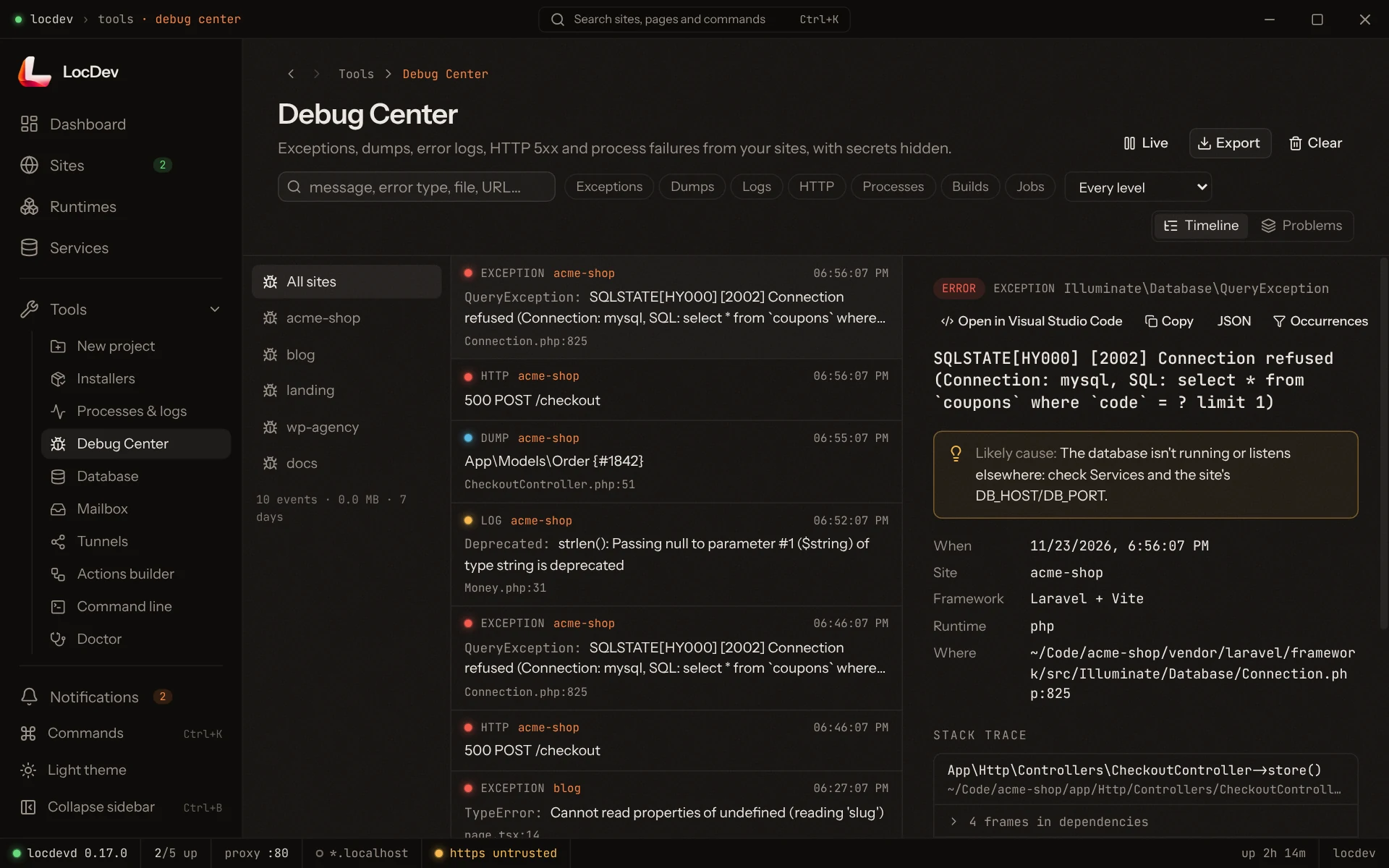
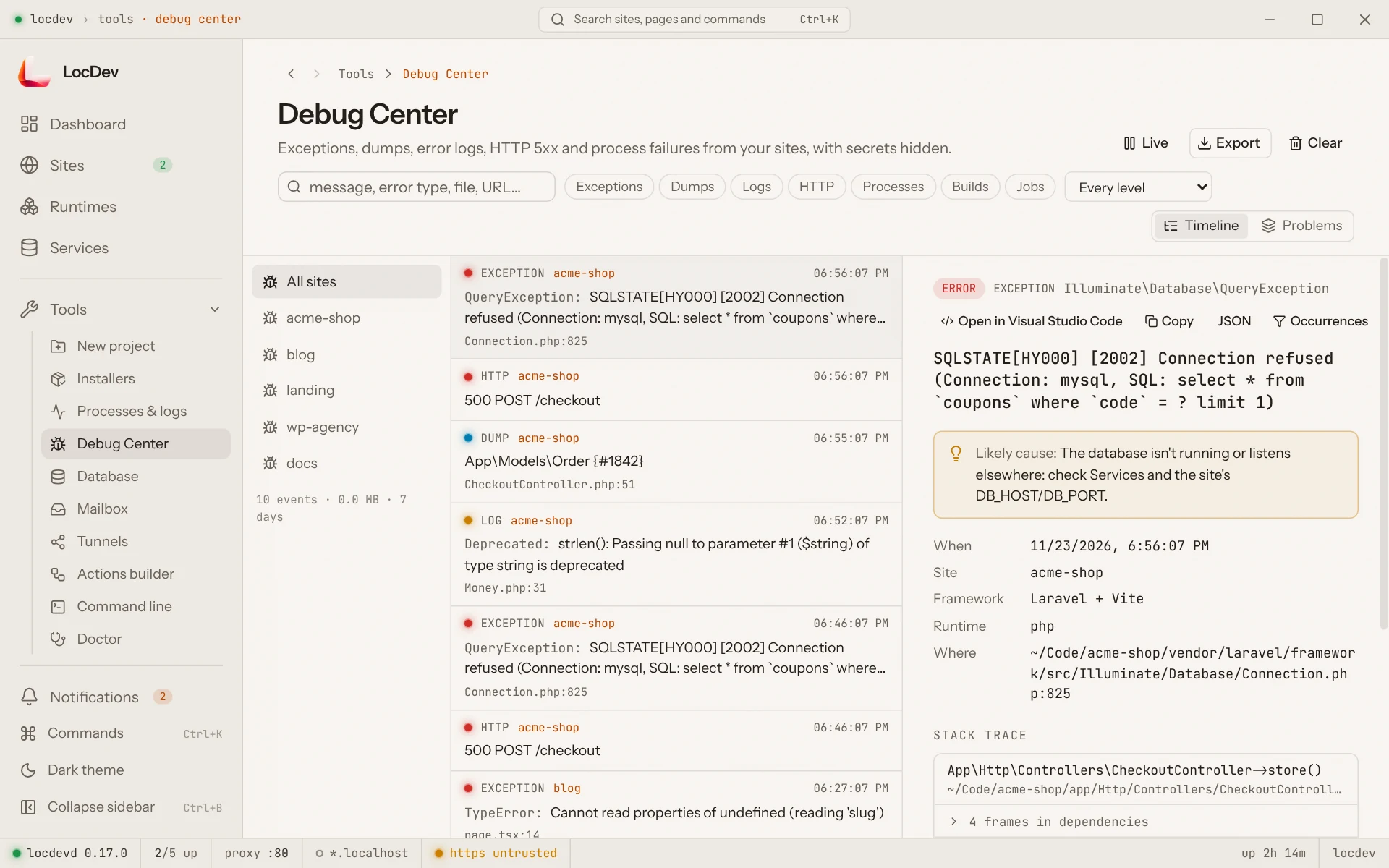
In Tools → Debug Center (Ctrl Shift D) or with locdev debug, LocDev gathers what goes wrong in your sites in one place: exceptions with stack traces, PHP's dump()/dd(), warning and error log lines, 5xx answers, processes that crashed, builds that failed and LocDev jobs that errored. Secrets are hidden before anything is stored.
Where events come from
| Source | What becomes an event |
|---|---|
| Process output (site, helper dev server, auxiliary processes, services) | Exceptions and stack traces, build errors, PHP warnings and lines marked as warning or error |
Laravel's storage/logs (laravel.log and today's daily file) | Entries from the chosen level up, with the exception and its stack; only what's written after the site starts |
| LocDev's proxy | 5xx answers and sites that didn't answer (method, address, status and time) |
| Supervisor | Processes that exited with an error, with their last output lines |
| LocDev's dump server | dump() and dd() from PHP sites with capture on |
| Job queue | Jobs that failed (dependency checks, installs…) |
LocDev only reads: it doesn't change the project's logging setup or its files.
By runtime
| Runtime | What LocDev recognizes |
|---|---|
| PHP | PHP Fatal error: Uncaught … with Stack trace:; PHP Warning/Deprecated with file and line; the built-in server's format ([500]: GET /path - Uncaught …); Laravel's log; Symfony VarDumper dumps |
| Node.js | TypeError: … with at function (file:line:column) lines; Vite errors ([vite] Internal server error) and Next.js ones (⨯ …, Module not found); TypeScript errors (error TS2322) |
| Python | Traceback (most recent call last): through the Type: message line; logging's default format (ERROR:logger:message) |
| Rust | Panics (thread 'main' panicked at file:line:column:); cargo errors (error[E0425]); tracing's default format |
Dependency frames (vendor, node_modules, site-packages, the cargo registry) are folded in the stack. Other lines become events from the chosen level up (default: warnings) when they carry an explicit level (ERROR, [warn], npm ERR!…).
The page
- Timeline: newest events first, updated live (pause with Live).
- Problems: repeats grouped (same error type, same message once numbers and values are blanked, same place in the project's code), with the total and an hourly chart of the last 24 hours.
- Filters: site (on the left), kind, level and search by message, error type, file or URL.
- Detail: message, error type, framework, runtime, file and line, when it happened, the request (method, URL, status, time and controller, when known), the stack trace, the dumped value, the context and the text as written.
- Likely cause: for errors it knows (a database refusing connections, a port in use, a missing
APP_KEY, a class or module not found, a missing Vite manifest, PHP's memory limit…), a hint at what usually causes it. - Actions: Copy (text to paste in an issue), JSON, Occurrences (only that problem's repeats), Export (JSON Lines) and opening the file at the line in your code editor (on the event and on each stack frame inside the site).
PHP dumps (dump() and dd())
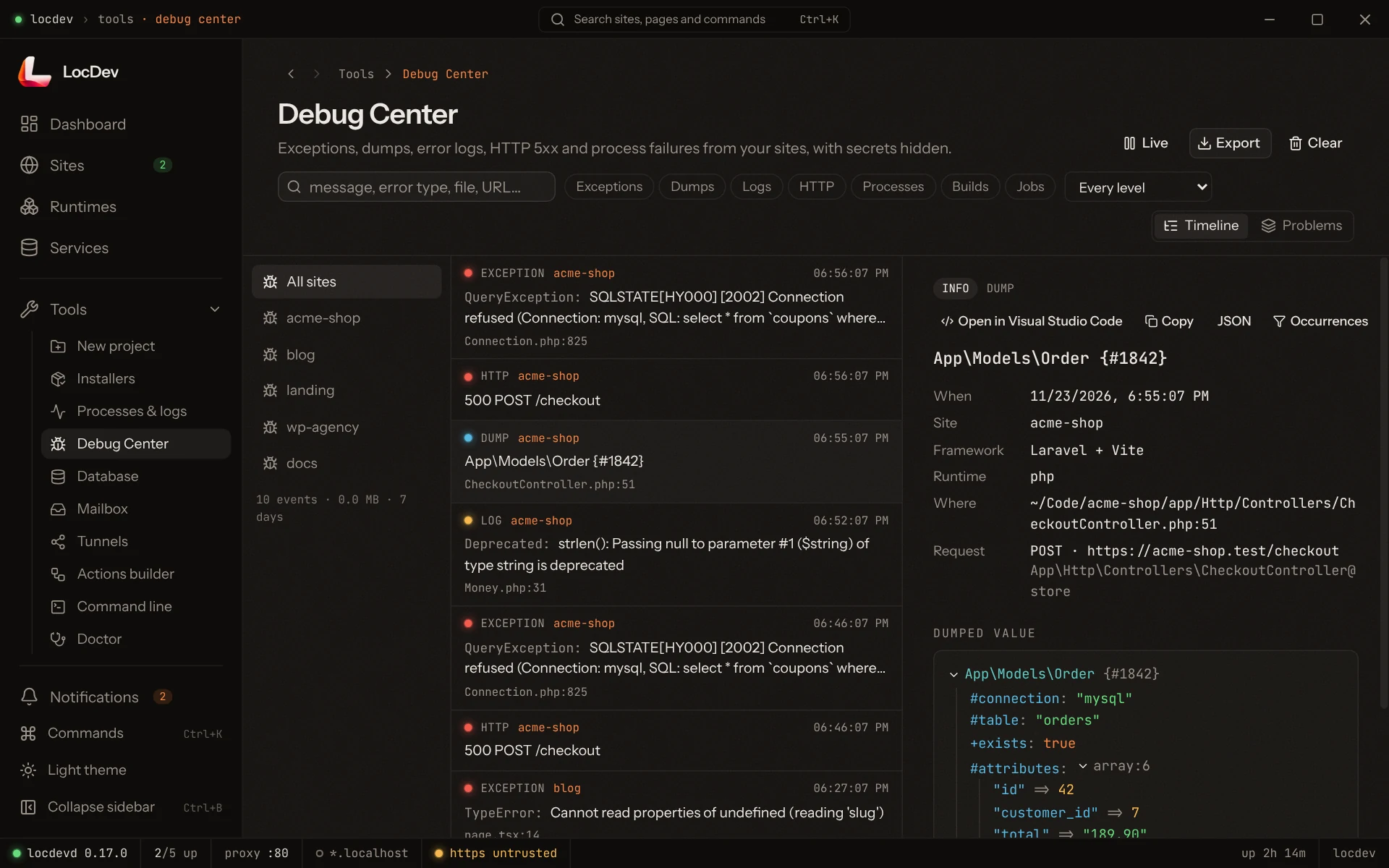
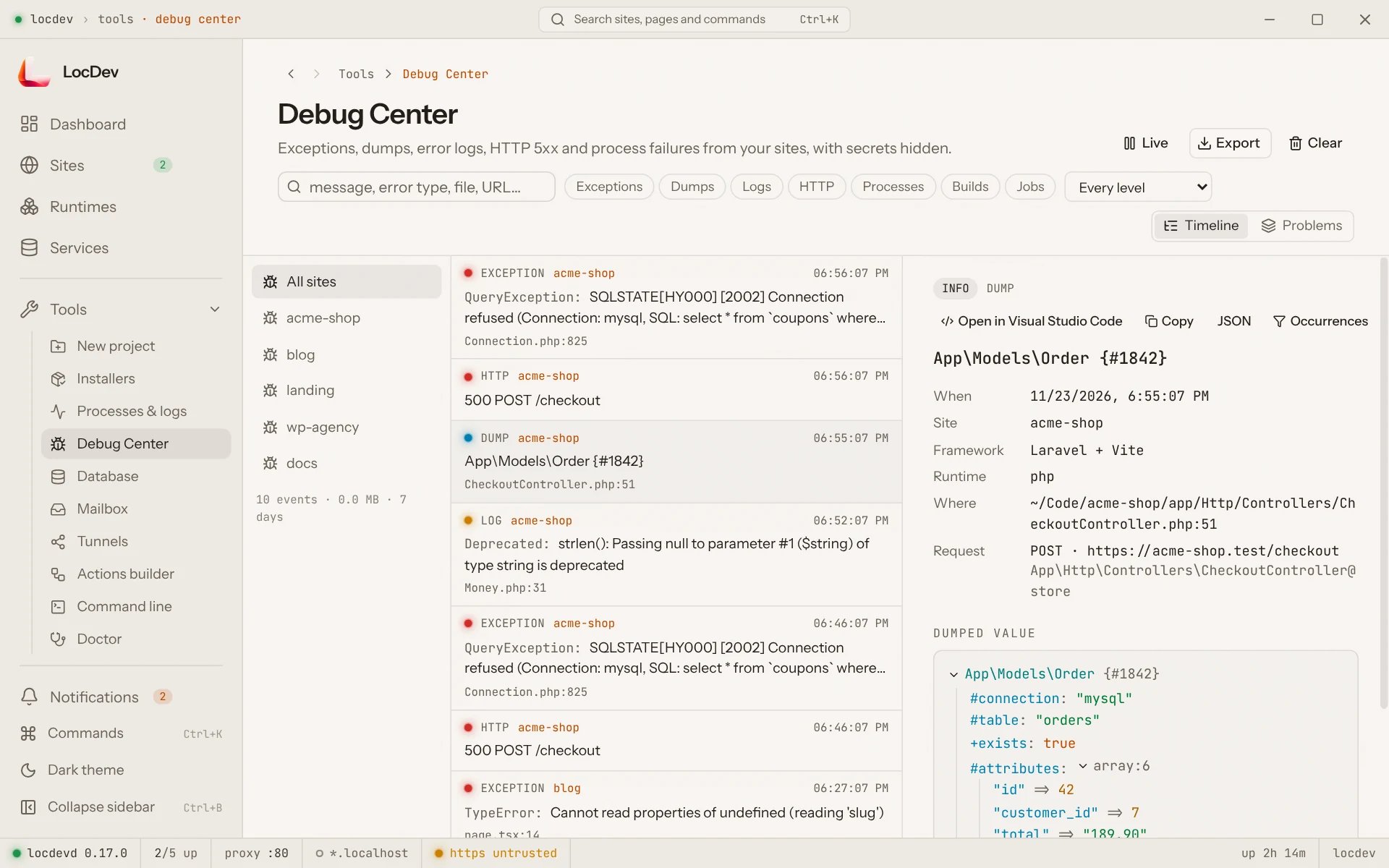
For PHP sites with Symfony VarDumper (Laravel, Symfony), pick the site on the left and turn on Capture dump() and dd() (or locdev debug dumps <site> on). The site restarts. From then on dumps show up in the Debug Center as a tree (arrays, objects with public +, protected # and private - properties, recursion marked) instead of on the page.
How it works, without changing any project file:
- LocDev sets
VAR_DUMPER_FORMAT=serverandVAR_DUMPER_SERVER=127.0.0.1:<port>in the site's process environment only. It's VarDumper's ownserverformat, which Laravel honors. - PHP's built-in server (
php -S, whichartisan serveuses) doesn't pass environment variables to$_SERVER, the only place VarDumper looks. So theauto_prepend_fileLocDev adds to PHP sites (indata/php-prepend/, marked "Managed by LocDev"; it also marks HTTPS requests, see HTTPS and the local CA) copies the two variables into$_SERVER. If your PHP already had anauto_prepend_file(Herd's, for instance), it still runs right after. - If LocDev's dump server doesn't answer, VarDumper prints the dump as usual.
dd()still ends the request: LocDev shows the value but doesn't keep whatever would have run after it.
LocDev reads PHP's serialization format itself, without running PHP or calling unserialize. Auxiliary processes LocDev runs for the site (queues, scheduler) get the same environment, so their dumps arrive too, with the command line in the context.
Secrets
Before storing or showing any event, LocDev hides ([redacted]):
- the values in the site's
.envand.env.local, except plain settings (hosts, ports, drivers, names, levels,true/false, numbers); - the values of the shared variables and secrets LocDev injects into the site;
Authorization,Cookie,Set-CookieandX-Api-Keyheaders;Bearertokens; JWTs;password=,token=,secret=,api_key=and the like in URLs and text; passwords in URLs (postgres://user:password@…);- in JSON and dumps, values of keys named like
password,token,secret,api_key,cookie,sessionor ending in_key.
This covers what's identifiable; a secret with no recognizable name, in a place with no pattern, can slip through. Events stay on this machine.
Storage and cleanup
Events live in data/observe/<site>/<day>.jsonl, the newest also in memory. In Settings → Automations → Debug Center:
- Collect events (on by default);
- Keep for (default: 7 days) and Use at most (default: 100 MB): when either limit is reached, the oldest days are deleted first;
- Plain log lines from: info, warnings (default) or errors.
Clear deletes a site's events (or all of them), in memory and on disk. The same options exist in settings.toml ([observe] enabled, retention_days, max_mb, logs_from).
Command line
locdev debug events
locdev debug errors
locdev debug status
locdev debug events -ffollows live;--site,--kind(repeatable),--leveland--searchfilter;--jsonfor scripts.locdev debug errorsgroups repeats, with the last 24 hours' chart.locdev debug show <id>prints a whole event (stack, request, dump, likely cause).locdev debug exportwrites JSON Lines;locdev debug clear --site <site>clears;locdev debug dumps <site> on|offturns dump capture on and off.
Limitations
- Validated on Linux: the whole pipeline with a real Python site (traceback, 500 at the proxy,
.envsecret hidden, grouping) and with real PHP 8.5 + Symfony VarDumper 7.4 through the built-in server (dump captured without showing on the page, exception with its request). Not tested with a full Laravel application, nor on Windows and macOS. - The Node.js, Next.js, Vite, Python and Rust formats follow each tool's default output; logs in a format of their own (structured JSON, for example) become events only when they carry an explicit level.
- Laravel's log is read for the
singleanddailychannels instorage/logs; other destinations (Papertrail, syslog, stderr) aren't. - Errors that only happen in the browser (front-end JavaScript) don't go through LocDev.