
Environment variables and secrets
LocDev keeps variables you want to use across projects (Stripe keys, a Sentry DSN, API tokens) and hands them to the sites' processes without changing .env files. Files only change when you ask, with locdev env sync.
Where they live
| What | Where |
|---|---|
| Profiles, names, non-secret values, each site's choices | config/env.toml (0600) |
| Secret values | data/state/env-vault.json, encrypted with ChaCha20-Poly1305 |
| Vault key | the system keyring (Secret Service on Linux, Keychain on macOS, Credential Manager on Windows) |
| Change history | data/state/env-history.json, without values |
.env backups | data/state/env-backups/<site>/, encrypted with the same key |
Each secret value is sealed together with its own name (AEAD associated data): a value copied to another key in the file won't open. If the key disappears from the keyring, LocDev doesn't create another (that would effectively wipe the secrets): it warns in doctor, plain variables keep working and secret ones stop being injected.
Machines without a keyring (a server with no graphical session, for example) can keep the key in a file:
# config.toml
[env]
key_store = "file"   # env-vault.key (0600) next to this file
In that mode the key file is as sensitive as the secrets themselves, and doctor shows a warning.
By default, a new variable is secret. The exception is the prefixes frameworks embed in browser code (NEXT_PUBLIC_, VITE_, NUXT_PUBLIC_, PUBLIC_, REACT_APP_, GATSBY_, EXPO_PUBLIC_, VUE_APP_): those are public and can't be secret. Variables LocDev or the system controls (PATH, HOME, PORT, HOST, NODE_OPTIONS, LD_*, DYLD_*, LOCDEV_*…) can't be shared either.
Profiles and inheritance
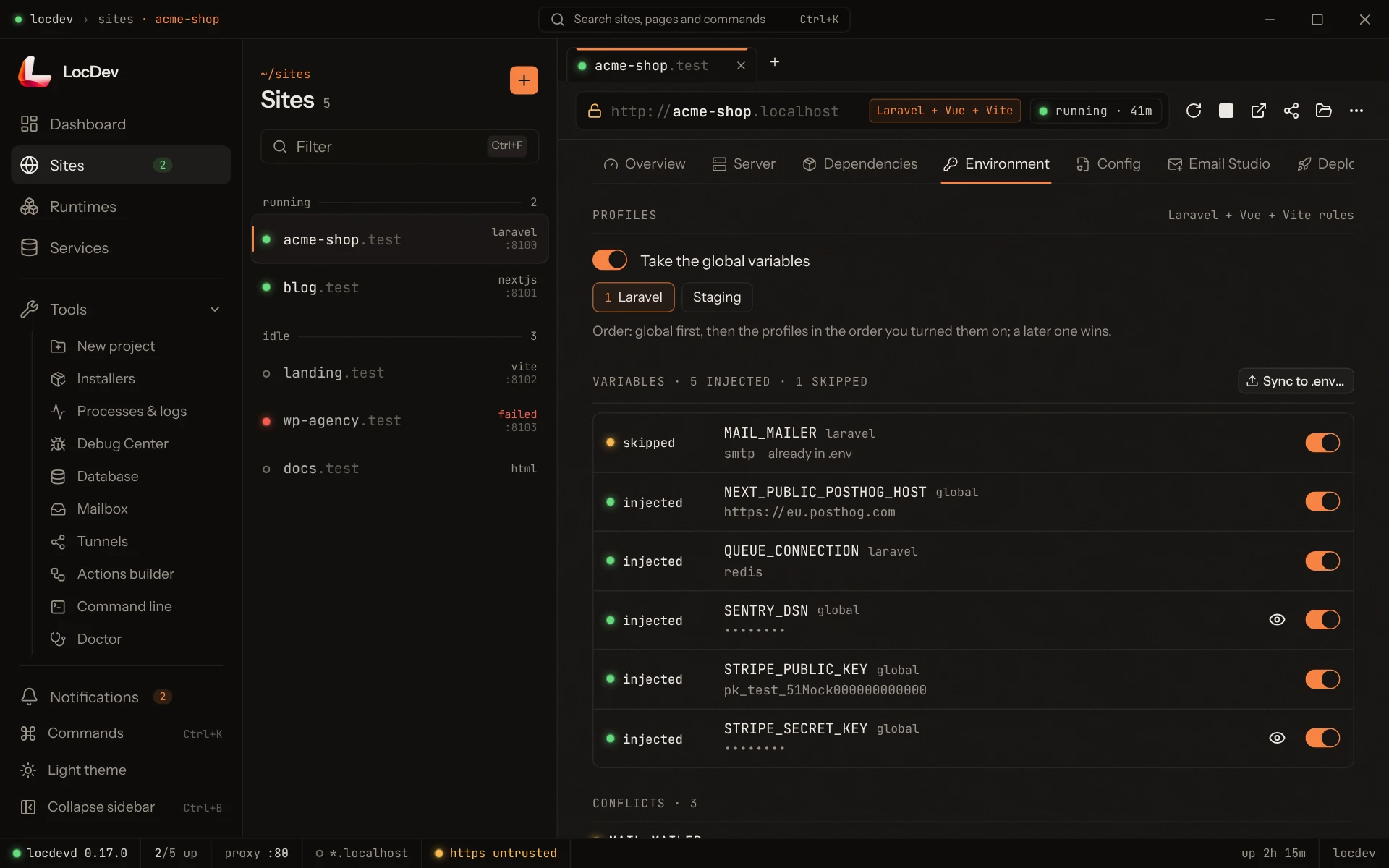
- global: every site gets it, unless it turns off Take the global variables (
locdev env use <site> --global false). - Other profiles (Laravel, Staging, a client…): apply only to the sites that turn them on. The order is global first, then the profiles in the order they were turned on; the last one wins, and what was overridden shows as
overridden. - A key can be turned off for a site (
--disable KEY), whatever its profile.
Injection and conflicts
When a site starts, the daemon resolves the variables and puts them only in the process environment. Nothing goes into command-line arguments, logs or temporary files.
Laravel (phpdotenv), Next.js (@next/env), Vite, Nuxt and the dotenv package prefer a variable that's already in the process environment over the file's value. So injecting a key the project already defines would silently replace the project's value. LocDev never does that: if the key exists in a file the dev server reads, it's skipped, and the site log records:
[LocDev] Warning: STRIPE_SECRET_KEY already exists in .env.local
[LocDev] Skipping shared variable STRIPE_SECRET_KEY (profile global).
What gets read depends on the framework (locdev env check shows each file's order):
| Framework | Files read in development (the first one wins) |
|---|---|
| Next.js | .env.development.local, .env.local, .env.development, .env |
| Vite, Astro, SvelteKit | .env.development.local, .env.development, .env.local, .env |
| Nuxt | .env |
| Laravel | .env (with bootstrap/cache/config.php, Laravel ignores the environment until php artisan config:clear, and LocDev warns) |
| PHP/WordPress | .env only with vlucas/phpdotenv, symfony/dotenv or roots/wp-config in composer.json |
| Node.js | .env only with dotenv; the file in node --env-file=… when the command uses it |
| Not recognized | .env.local and .env, to be safe |
Files the server doesn't read (.env.example, .env.production, .env.test) show up as an informational conflict and don't prevent injection. To skip in that case too:
locdev settings set env.conflicts any_file
Also skipped, with a warning, are keys already in the environment the daemon starts processes with, and keys LocDev itself sets for the process (such as APP_URL on Laravel's Vite). A secret with a public prefix is blocked.
Changes reach a running process only after it restarts; the site's Environment tab warns when the process has an old set. Public variables (NEXT_PUBLIC_, VITE_…) are embedded in the code at build time: restart the dev server and rebuild for production.
Syncing with files
locdev env sync copies into a project file the variables it's missing. Without a site, it applies to every registered site.
locdev env sync --dry-run              # all sites, only shows
locdev env sync shop                   # the shop site's .env
locdev env sync shop --file .env.local
locdev env sync shop --file .env.example
- It only appends lines at the end, under a LocDev comment. The file's comments, order, BOM and line endings (
\r\n) stay as they were. - It skips keys the file already has and keys defined in another file the server reads.
- It never copies secrets into
.env.production/.env.staging(nor their.localvariants). .env.example(and.sample,.dist,.template) gets only the names, with an empty value, secret or not, because those files usually go into Git.- The preview masks secrets. Writing only happens if the file and the variables are still the ones in the preview; otherwise LocDev asks for a new review.
- Before writing, it keeps an encrypted copy of the file (up to 20 per site):
locdev env backups shopandlocdev env restore <id> shop. Restoring also backs up the current file first. - It writes atomically, keeps the file's permissions and refuses symbolic links and files that aren't UTF-8.
Commands
locdev env list                         # variables (secrets masked) and the vault
locdev env add STRIPE_SECRET_KEY        # the value comes from standard input (out of shell history)
locdev env add SENTRY_DSN https://… --plain
locdev env add QUEUE_CONNECTION redis --plain --profile laravel
locdev env show STRIPE_SECRET_KEY --reveal
locdev env remove SENTRY_DSN
locdev env profile add laravel --label Laravel
locdev env use shop --add-profile laravel --disable SENTRY_DSN
locdev env check shop                   # what the process gets, files and conflicts
locdev env conflicts shop
locdev env history                      # changes, without values
--reveal asks for the LocDev password when locdev security requires one, and is recorded in the history. The password protects what goes through LocDev, not the vault file.
In the app
- Settings → Environment: variables with search and a profile filter, reveal/hide secrets, create, edit and remove (with confirmation), profiles, conflict policy, history and bulk sync.
- Site → Environment: the site's profiles and their order, each variable's state (
injected,skipped,overridden,off,blocked) with the reason, a per-key switch, conflicts, the.envfiles with their read order, sync and backups.
Limits
- Injection applies to processes started by LocDev. A
php artisanornpm runrun in your terminal doesn't get the variables. - Only the
.env*files at the project root are read; in monorepos, each registered site is analyzed in its own folder. - The keyring was tested for real on Linux (Secret Service). Keychain and the Windows Credential Manager use the same library, but haven't been validated on those systems yet.