
Email Studio
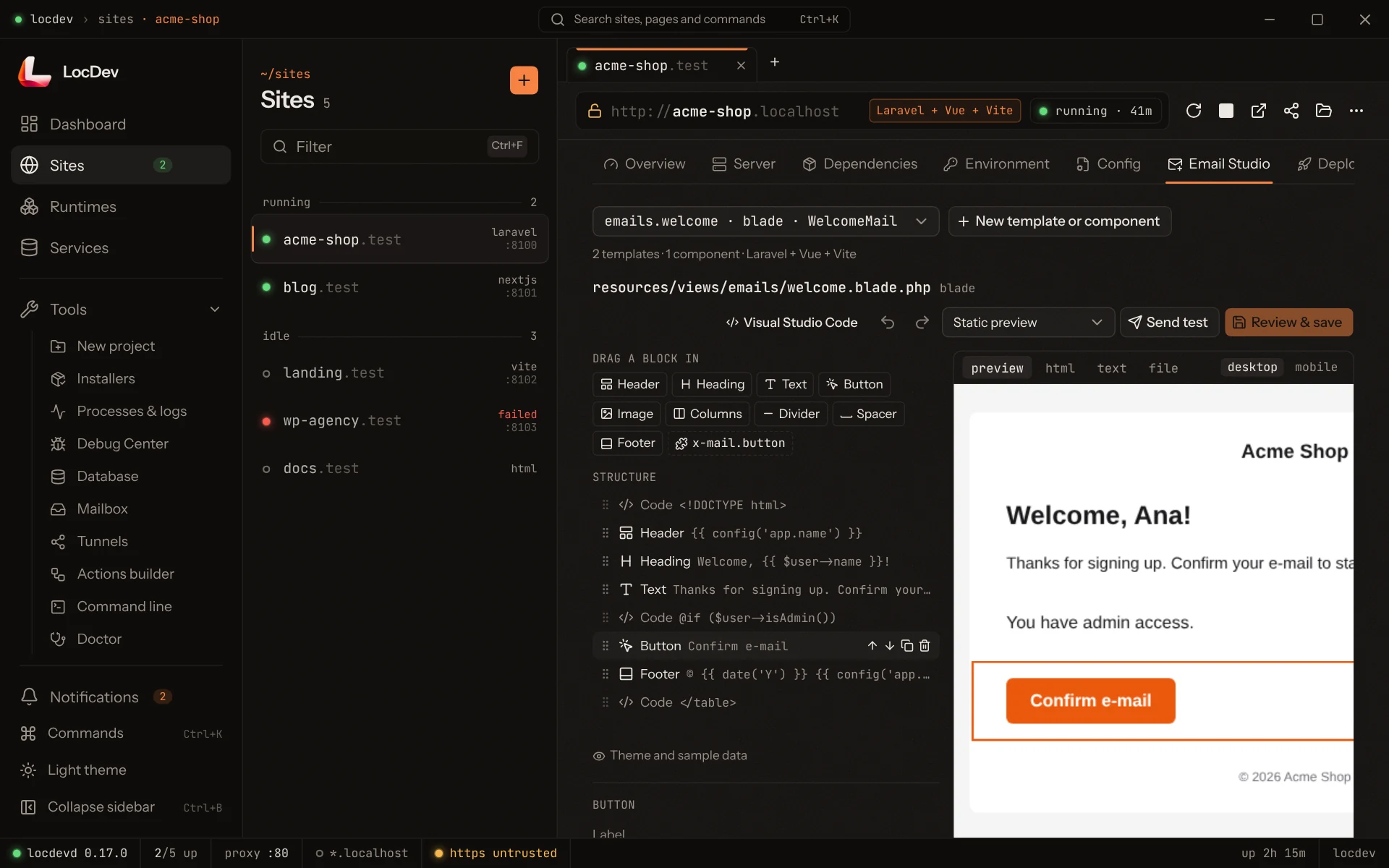
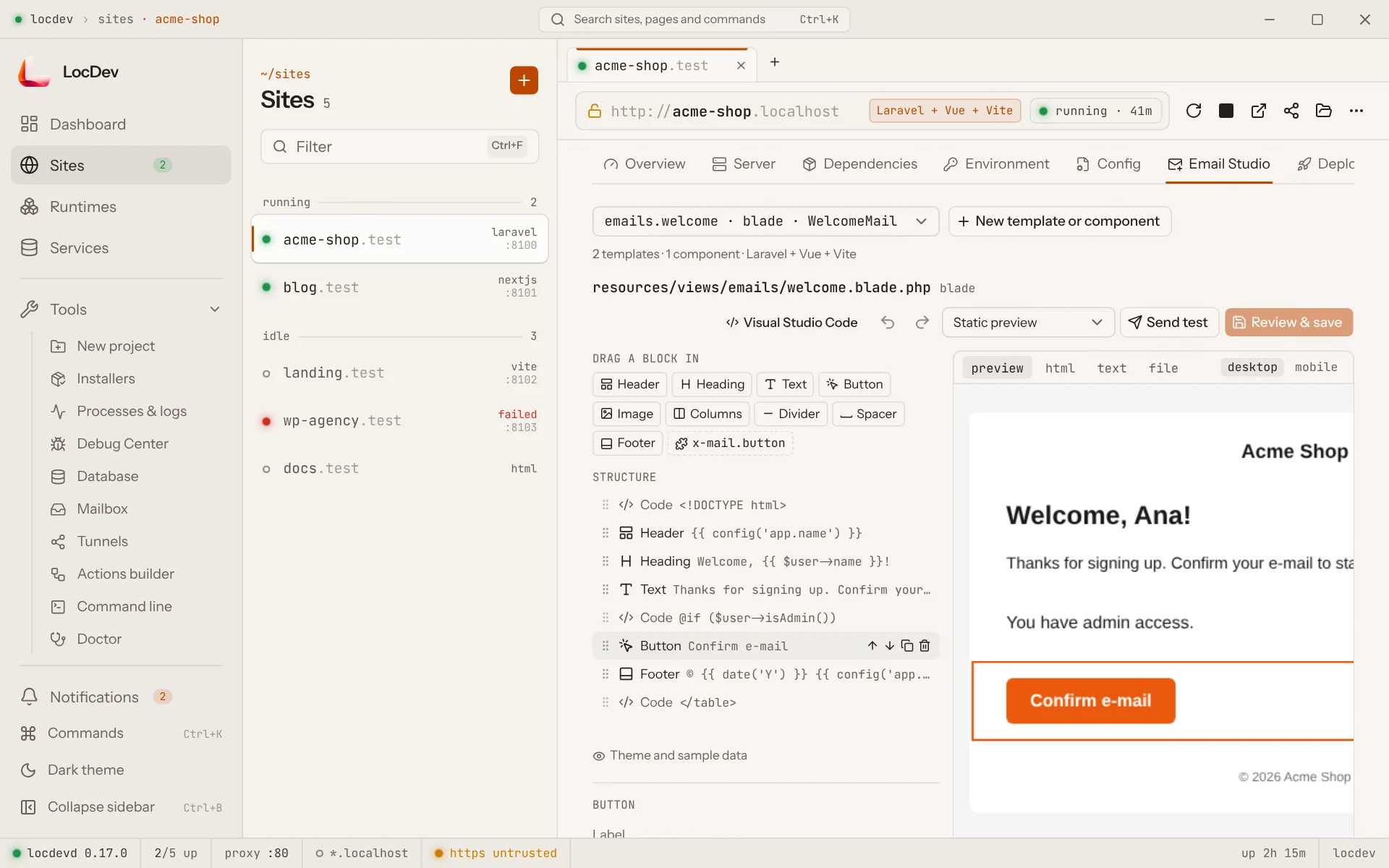
Each site's Email Studio tab brings together the project's email templates and components, with a visual block editor, live preview and test sends to the Mailbox. The files edited are the project's own, and Blade stays intact.
locdev new email contact                   # Laravel: make:mail + a view with blocks
locdev new email receipt --markdown        # Markdown mailable
locdev new email component button          # <x-mail.button>
locdev email list                          # templates, mailables and components
locdev email preview <path> --framework    # rendered by Laravel itself
locdev email send-test <path>              # to the Mailbox, never outside
What is discovered
| Stack | Templates | Components |
|---|---|---|
| Laravel | views in resources/views inside mail, mails, email or emails folders, and any view a Mailable in app/Mail uses (view:, html:, text:, markdown:). Shows the Mailable, the variables (public properties and with: keys) and the format: Blade, Markdown (<x-mail::message>) or text. | resources/views/components/mail/*.blade.php, used as <x-mail.name>. Properties come from Blade's own @props([...]). Laravel's Markdown components (x-mail::button, panel…) show up in Markdown templates. |
| Other stacks | emails/, templates/emails/ (Django), app/views/*_mailer/ (Rails), .mjml and React Email (.tsx) | emails/components/*.html with <!-- locdev:component {"props":[...]} --> |
Nothing runs to discover them: files are only read. MJML, React Email, ERB and Django templates are edited as code; visual blocks work in Blade, Markdown mailables and HTML.
How editing preserves the template
The editor works with segments:
-
LocDev blocks (header, heading, text, button, image, columns, divider, spacer, footer, panel, component). Each sits between two comments in the template itself, which don't go into the sent email:
BLADE{{-- locdev:block {"type":"button","props":{"text":"Pay","url":"{{ $url }}"},"h":"3fa1c2d0"} --}} <tr><td …><a href="{{ $url }}" …>Pay</a></td></tr> {{-- /locdev:block --}}Texts accept Blade expressions (
{{ $user->name }}), which go into the file as written; the rest is escaped. In components, a value starting with$becomes a binding (:url="$url"). -
Code: everything outside the blocks, such as
@if,@foreach,{!! !!},@propsand the layout, is kept exactly as it is. Code can be dragged and edited as text, but the visual editor never rewrites it.
Opening and saving without changes gives back the file byte for byte. When a block changes, only its lines change.
Edited in your IDE? Each block keeps a hash of the markup it generated. If that markup was changed outside LocDev, the block shows as edited and is kept as you wrote it, until you ask for Regenerate from properties.
Syncing with the IDE
- Outside changes: the app checks the file every 2 seconds. If it changed and you have no pending changes, the screen reloads by itself. If you do, a notice offers Load theirs (discards yours) or Keep mine (when saving, the diff shows what will change relative to the new file).
- Saving: always shows the diff first and only writes if the file is still the one you reviewed. The previous version goes to the history, and the write is atomic.
- Undo and redo:
Ctrl+ZandCtrl+Ywork inside the editor.
Preview and sample data
- Static preview: LocDev substitutes sample data (
$user->name,$order['id'],?? 'default',config(),__(),route(),date('Y')) and expands the project's components, without running anything. Blade logic isn't evaluated, so both sides of an@ifshow, and the screen says so. The selected block is highlighted in the preview. - Framework preview (Laravel):
- Laravel itself renders it, with
view()or the mailables'Markdown::render; - it runs in a separate process, with a reduced environment (the site's PHP,
HOME,APP_ENV=localand mail pointed at the Mailbox), a 25-second limit and limited output; - unsaved content goes to a LocDev temporary file, never into the project;
- it needs
vendor/installed.
- Laravel itself renders it, with
- Views: desktop or mobile, the generated HTML, the text version and the file that would be written.
- Sample data: suggested from the template's variables, editable as JSON and kept by LocDev, outside the project. Send test renders and sends to the Mailbox.
Generator
locdev new email <name> follows the framework's structure and never overwrites an existing file:
- Laravel: runs
php artisan make:mail <Name>Mail --view=emails.<name>(or--markdown), Laravel's own generator, and fills the new view with a block template. Without PHP orvendor/, it creates only the view and shows the command to create the Mailable. - Components:
resources/views/components/mail/<name>.blade.php, with@propsand a description in a comment.button,headerandfootercome with their own template. - Other stacks:
emails/<name>.htmlandemails/components/<name>.html.
In the app, the same lives in New template or component. The project can be chosen explicitly with --site.
Limitations
- Plain HTML components don't become visual blocks yet; edit them as code.
- The code editor has syntax highlighting (Blade, HTML, Markdown), search (
Ctrl+F) and undo, but no autocomplete for the template's variables. - The framework preview only exists for Laravel. On other stacks, use the static preview or the framework's own tool.