
Mailbox
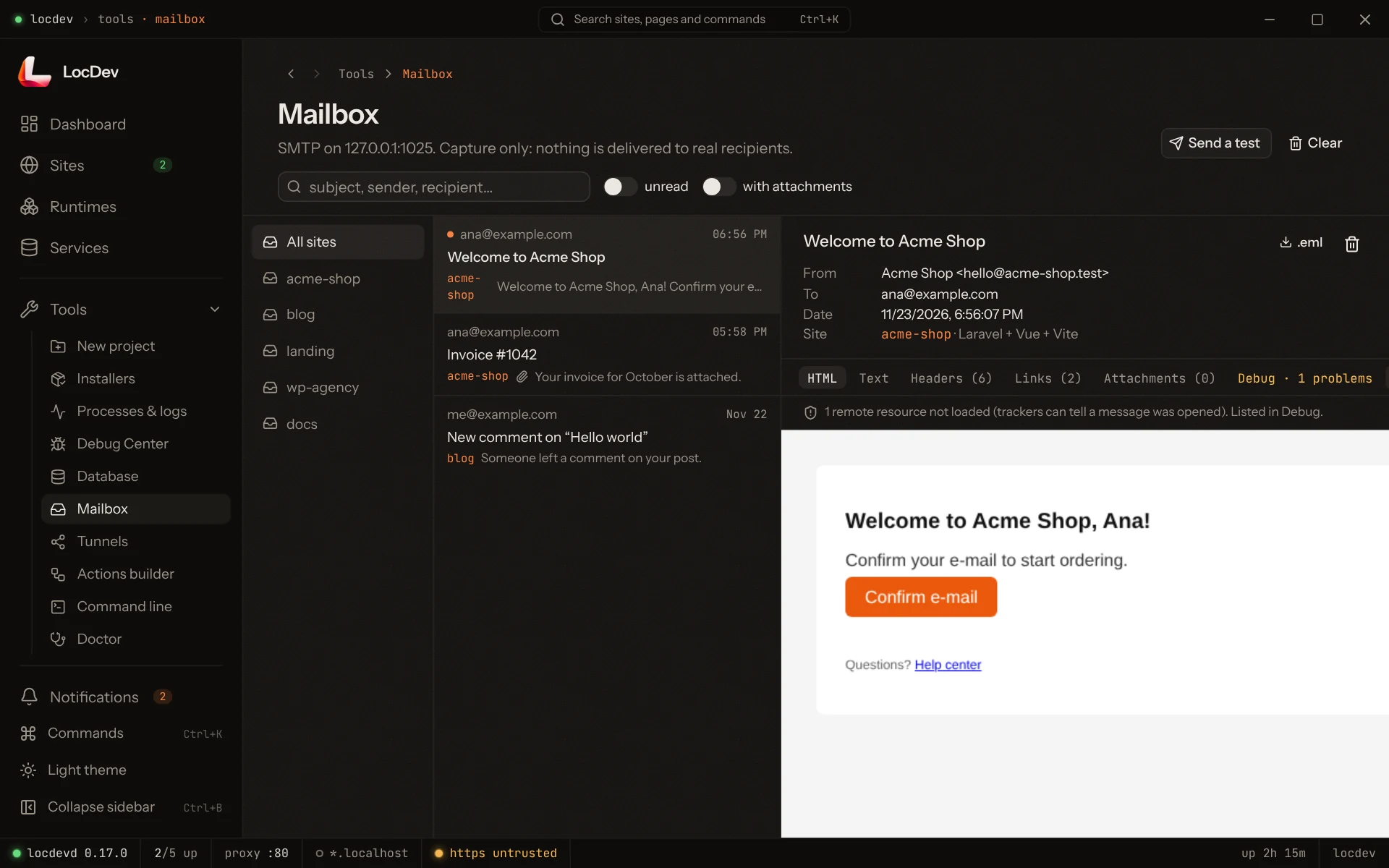
LocDev has its own test inbox: an SMTP server that only captures. It listens on 127.0.0.1:1025 (or the next free port, if Mailpit is already there) and keeps everything it receives, delivering nothing to anyone. There's no extra tool to install.
locdev mail enable shop          # shop's email goes to the Mailbox
locdev mail list                 # messages, newest first
locdev mail show <id>            # envelope, text, links, attachments and problems
locdev mail raw <id> -o msg.eml  # the message exactly as it arrived
locdev mail test                 # send a test message to the Mailbox
In the app: Tools → Mailbox. To turn a site on, use Site → Settings → mail.
How each framework is wired
LocDev doesn't intercept traffic. It sets the SMTP transport explicitly, only in the environment of the site's processes (server, workers, scheduler). The project's .env is never edited. After turning it on or off, restart the site.
| Stack | How |
|---|---|
| Laravel | MAIL_MAILER=smtp, MAIL_HOST, MAIL_PORT, MAIL_USERNAME (the site's name), MAIL_PASSWORD, plus MAIL_SCHEME (Laravel 11+) or MAIL_ENCRYPTION=null (10 and earlier), depending on what the project's config/mail.php reads. An existing MAIL_URL is cleared, because it wins over MAIL_HOST. |
| WordPress and PHP | PHP's mail() goes through sendmail_path, which comes from a LocDev .ini added with PHP_INI_SCAN_DIR (the system's .ini files still apply). On Windows, the .ini uses SMTP/smtp_port. SMTP plugins (WP Mail SMTP and the like) don't go through mail() and need to point to 127.0.0.1 as well. |
| Node.js, Django, Rails and others | If the project's .env/.env.example already has SMTP_*, MAIL_*, EMAIL_* or MAILER_* variables (HOST, PORT, USER, PASS, SECURE, URL…), LocDev sets those same variables. If the framework reads SMTP straight from code (settings.py, development.rb, nodemailer.createTransport), the screen shows the exact snippet to add to the development environment. |
Each site's SMTP user is its name, and that's how the Mailbox knows which project each message came from. The server accepts any password and doesn't offer STARTTLS (it's loopback).
Real SMTP: only with your authorization
If the project points to a real server, turning the Mailbox on needs explicit consent: locdev mail enable --override-real, or the "Allow replacing it" box in the app. That applies to a host that isn't local or to an API transport such as SES, Postmark, Mailgun or Resend. Passwords from .env never show on screen.
The inbox
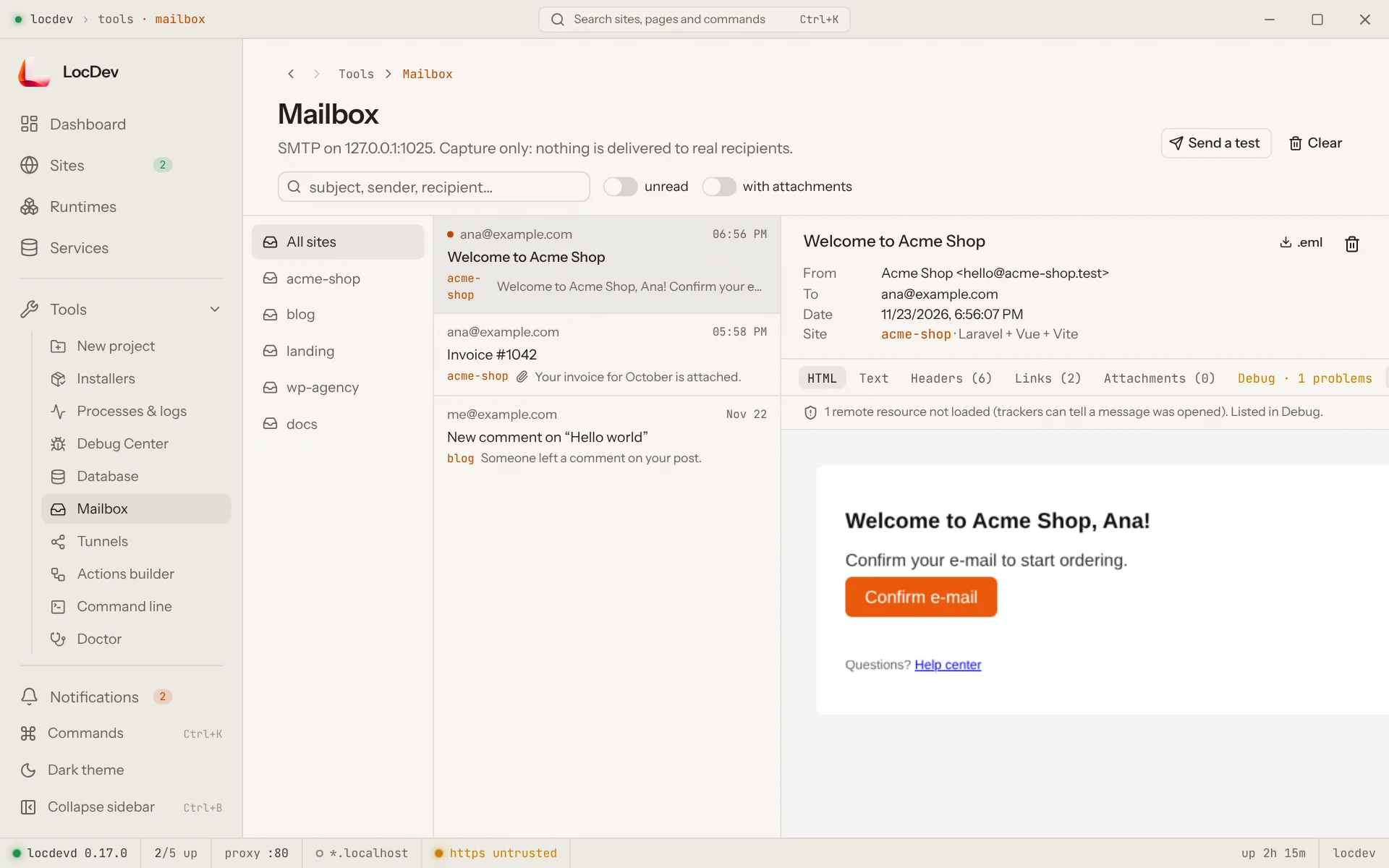
- Organization: a general inbox and one per site, with search by subject, sender, recipient or snippet, and filters for unread and with attachments.
- Views: HTML, text, headers, links, attachments (with download) and the original
.eml. - Debug: shows what the SMTP session actually reported:
- the envelope (
MAIL FROM,RCPT TO) andHELO; - the protocol (
ESMTPAwhen it authenticated) and theAUTHuser; - the source address, the arrival time, the message's
Date, the size and the site's framework.
- the envelope (
- Formatting problems: objective checks.
- Missing
From,Date,Message-IDorSubject, and an invalidDate(RFC 5322). - Lines over 998 characters and 8-bit content without MIME.
- Decoding errors (base64, quoted-printable, charset).
- HTML without a text alternative and
cid:without the matching part.
- Missing
Isolated HTML
The email's HTML is shown in an iframe with an empty sandbox, with no scripts, forms, navigation or pop-ups. On top of that, a security policy blocks every network load, so tracking pixels and remote images don't load. The screen says how many remote resources were blocked and the Debug tab lists them. Embedded images (cid:) show normally. Links don't open by clicking inside the email; use the Links tab, which opens the address in the browser.
Each captured message also becomes a notification (the Captured emails category), shown by the system when the app isn't in front, and lights the green dot on the tray icon (App tour). Opening or deleting the message marks the notification read.
Storage
Messages are kept in data/mail/messages (a 0700 folder), each as an .eml plus a .json with the envelope. The last 1,000 are kept and, besides that, messages over 25 MB are refused. To delete: locdev mail delete, locdev mail clear [site] or the app's buttons.
On Laravel, LocDev runs
artisan servewith--no-reload. Without it,servedrops the variables LocDev injects before starting the PHP server (the PHP builds ship withvariables_order=EGPCS). After editing.env, restart the site.